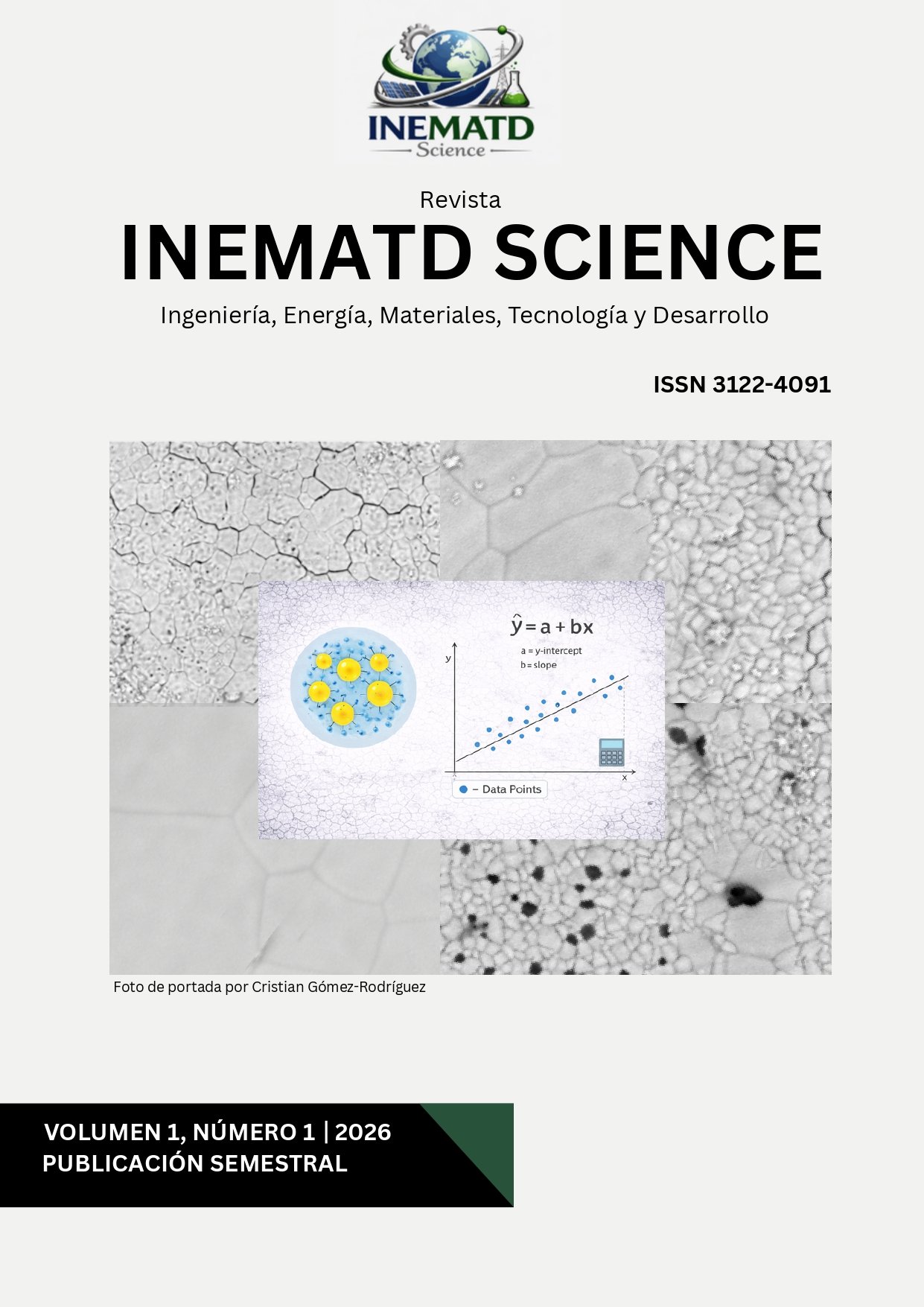
Predicción de arsénico remanente en su extracción con quitosano mediante un modelo polinomial obtenido con el modelo de superficie de respuesta (MSR).
DOI:
https://doi.org/10.67158/2dtrz624Keywords:
arsénico, modelo polinomial, contaminante, adsorción, MSRAbstract
Se propone un modelo polinomial, expresado en variables codificadas y naturales, para predecir la cantidad de arsénico remanente al efectuar la extracción de dicho contaminante en medio acuoso empleando quitosano como medio adsorbente. Se aplica el Método de Superficie de Respuesta (MSR) considerando las condiciones de pH, tiempo de contacto, concentración de arsénico y concentración del adsorbente (quitosano) para proponer las condiciones óptimas en las que aumenta la remoción de arsénico. El modelo polinomial propuesto presenta una buena aproximación, pues el coeficiente de determinación obtenido es de 0.9983. Se presentaron curvas de nivel y análisis residuales para la validación del modelo. Este trabajo pretende ser de ayuda para la predicción de arsénico remanente y así disminuir la cantidad de experimentos a realizar en el análisis de extracción de arsénico mediante quitosano.
References
[1] H. Choi, S.-K. Park, D.-S. Kim, and M. Kim, “Determination of 6 arsenic species present in seaweed by solvent ex-traction, clean-up, and LC-ICP/MS,” Food Sci. Biotechnol., vol. 20, no. 1, pp. 39–44, Feb. 2011, doi: 10.1007/s10068-011-0006-9. DOI: https://doi.org/10.1007/s10068-011-0006-9
[2] K. C. M. Kwok, L. F. Koong, G. Chen, and G. McKay, “Mechanism of arsenic removal using chitosan and na-nochitosan,” J. Colloid Interface Sci., vol. 416, pp. 1–10, Feb. 2014, doi: 10.1016/j.jcis.2013.10.031. DOI: https://doi.org/10.1016/j.jcis.2013.10.031
[3] C. Wang, H. Liu, Y. Zhang, C. Zou, and E. J. Anthony, “Review of arsenic behavior during coal combustion: Volati-lization, transformation, emission and removal technologies,” Prog. Energy Combust. Sci., vol. 68, pp. 1–28, Sep. 2018, doi: 10.1016/j.pecs.2018.04.001. DOI: https://doi.org/10.1016/j.pecs.2018.04.001
[4] N. Horzum, M. M. Demir, M. Nairat, and T. Shahwan, “Chitosan fiber-supported zero-valent iron nanoparticles as a novel sorbent for sequestration of inorganic arsenic,” RSC Adv., vol. 3, no. 21, p. 7828, 2013, doi: 10.1039/c3ra23454a. DOI: https://doi.org/10.1039/c3ra23454a
[5] M. Moradi, M. Fazlzadehdavil, M. Pirsaheb, Y. Mansouri, T. Khosravi, and K. Sharafi, “Response surface methodology (RSM) and its application for optimization of ammonium ions removal from aqueous solutions by pumice as a natural and low cost adsorbent,” Archives of Environmental Protection, vol. 42, no. 2, pp. 33–43, Jun. 2016, doi: 10.1515/aep-2016-0018. DOI: https://doi.org/10.1515/aep-2016-0018
[6] I. K. Basha, E. M. Abd El-Monaem, R. E. Khalifa, A. M. Omer, and A. S. Eltaweil, “Sulfonated graphene oxide im-pregnated cellulose acetate floated beads for adsorption of methylene blue dye: optimization using response surface methodology,” Sci. Rep., vol. 12, no. 1, p. 9339, Jun. 2022, doi: 10.1038/s41598-022-13105-4. DOI: https://doi.org/10.1038/s41598-022-13105-4
[7] M. O. Ani, M. C. Menkiti, and L. N. Emembolu, “Characterizations of a functionalized disused plastic-derived membrane and investigation of the effects of process variables on its adsorptive uptake of Pb2+ from simulated effluent using response surface methodology,” Waste Management Bulletin, vol. 2, no. 2, pp. 66–82, Jun. 2024, doi: 10.1016/j.wmb.2024.03.005. DOI: https://doi.org/10.1016/j.wmb.2024.03.005
[8] R. H. . Myers, D. C. . Montgomery, and C. M. . Anderson-Cook, Response surface methodology : process and product optimization using designed experiments, 3rd ed. Wiley, 2009.
[9] M. H. Dehghani, M. Maroosi, and Z. Heidarinejad, “Experimental dataset on adsorption of Arsenic from aqueous solution using Chitosan extracted from shrimp waste; optimization by response surface methodology with central composite design,” Data Brief, vol. 20, pp. 1415–1421, Oct. 2018, doi: 10.1016/j.dib.2018.09.003. DOI: https://doi.org/10.1016/j.dib.2018.09.003
[10] A. Weremfo, S. Abassah‐Oppong, F. Adulley, K. Dabie, and S. Seidu‐Larry, “Response surface methodology as a tool to optimize the extraction of bioactive compounds from plant sources,” J. Sci. Food Agric., vol. 103, no. 1, pp. 26–36, Jan. 2023, doi: 10.1002/jsfa.12121. DOI: https://doi.org/10.1002/jsfa.12121
[11] Y. Yang et al., “Adsorption property of fluoride in water by metal organic framework: Optimization of the process by response surface methodology technique,” Surfaces and Interfaces, vol. 28, p. 101649, Feb. 2022, doi: 10.1016/j.surfin.2021.101649. DOI: https://doi.org/10.1016/j.surfin.2021.101649
[12] J. Du, Y. Li, G. Jin, J. Wang, and L. Chen, “Determination and correlation of solubility of 2,4,6,8,10,12-Hexacyclopropyl-2,4,6,8,10,12-hexaazaisowurtzitane in 12 pure solvents at temperatures ranging from 278.15K to 318.15K,” J. Chem. Eng. Data, vol. 70, no. 10, pp. 4302–4314, Oct. 2025, doi: 10.1021/acs.jced.5c00434. DOI: https://doi.org/10.1021/acs.jced.5c00434
[13] S. Imame et al., “Utilization of maize pith powder as a cost-effective adsorbent for the removal and analysis of Crystal Violet from aqueous solutions before determination by UV-Vis spectrophotometry,” Analytical Methods in Environ-mental Chemistry Journal, vol. 8, no. 2, pp. 5–25, Jun. 2025, doi: 10.24200/amecj.v8.i02.1010. DOI: https://doi.org/10.24200/amecj.v8.i02.1010
[14] S. H. Alrefaee et al., “Adsorption and effective removal of organophosphorus pesticides from aqueous solution via novel metal-organic framework: Adsorption isotherms, kinetics, and optimization via Box-Behnken design,” J. Mol. Liq., vol. 384, p. 122206, Aug. 2023, doi: 10.1016/j.molliq.2023.122206. DOI: https://doi.org/10.1016/j.molliq.2023.122206
[15] N. P. Sibiya, G. Amo-Duodu, E. K. Tetteh, and S. Rathilal, “Model prediction of coagulation by magnetised rice starch for wastewater treatment using response surface methodology (RSM) with artificial neural network (ANN),” Sci. Afr., vol. 17, p. e01282, Sep. 2022, doi: 10.1016/j.sciaf.2022.e01282. DOI: https://doi.org/10.1016/j.sciaf.2022.e01282
Downloads
Published
Issue
Section
License
Copyright (c) 2026 Revista INEMATD SCIENCE - ISSN 3122-4091

This work is licensed under a Creative Commons Attribution 4.0 International License.
Los artículos publicados en esta revista se distribuyen bajo la licencia Creative Commons Reconocimiento 4.0 Internacional (CC BY 4.0), que permite el uso, distribución y reproducción en cualquier medio, siempre que se otorgue el crédito adecuado a los autores y a la revista. https://creativecommons.org/licenses/by/4.0/